Every car has a story. Here's this one: a tale of how the digital world meets the analogue soul of a chassis. When I walk the Pebble Beach lawn, I see cars born from hand-beaten aluminum and drawn with pencil on vellum. But the cars that make my heart race fastest today are the ones that combine that heritage with the quiet hum of a computer doing finite element analysis. **FEA in car chassis design** isn't just engineering jargon—it's the reason a modern 911 GT3 or a new Alfa Romeo Giulia Quadrifoglio can be both lighter and more rigid than their ancestors. And for a driver, that means a car that talks back to you through the steering wheel, not through a numb, heavy structure.
What Is FEA and Why It Matters for Chassis Design
Finite Element Analysis, or FEA, is a computerized method for predicting how a structure reacts to real-world forces—stress, torsion, vibration, and crash loads. Instead of building twenty prototype chassis and testing them to destruction, engineers create a digital model, divide it into tiny elements (the "finite" part), and simulate how each element behaves under load. The result is a chassis that uses material exactly where it's needed and removes it where it isn't. For a performance car, that means lower weight, higher torsional rigidity, and a center of gravity that makes cornering feel telepathic. Today, **FEA in car chassis design** is so precise that the first physical prototype often needs only a few tweaks. It's a far cry from the days when Enzo Ferrari would tell his engineers to add a few kilos of tubing and hope for the best.
From Torsion Bars to Digital Twins: A Heritage Perspective
Heritage Note: I remember my grandfather telling me about the 1954 Lancia Aurelia B20—the first production car with a monocoque chassis. Lancia's engineers used hand calculations and intuition to create a structure that was both stiff and light. Fast-forward seventy years, and we have digital twins that simulate the same loads in hours. But the goal hasn't changed: a chassis that protects you, communicates the road, and doesn't waste a gram. When I took my 1972 Alfa Spider to the track last year, I felt its flex—the steering would wander a bit over bumps, the doors would creak. That car has character, but it's a character born from limitations. Modern **FEA in car chassis design** doesn't eliminate character; it refines it. The new Alfa Romeo 4C, for example, uses a carbon fiber monocoque developed with extensive FEA. It's immensely stiff, and you feel that in the precision of its turn-in. The soul is still there—it just has better posture.

How FEA Shapes Today's Performance Cars
Walk through the paddock at Laguna Seca, and you'll see the fruits of FEA everywhere. Take the Porsche 911 GT3 RS. Its chassis uses a mix of aluminum and high-strength steel, with a carbon-fiber roof and rear anti-roll bar. The engineers at Weissach ran thousands of FEA iterations to balance weight distribution and torsional rigidity. The result? A chassis that feels like a single spar, not a collection of pieces. Similarly, the Ferrari 296 GTB uses FEA to optimize its hybrid battery placement within the chassis, keeping mass low and central. Even heritage-heavy brands like Aston Martin lean on **FEA in car chassis design** to make their bonded aluminum structures whisper-quiet and track-ready. What's exciting is that FEA isn't just for exotics. The latest Mazda MX-5 Miata uses extensive FEA to keep its weight under 2,400 pounds while maintaining the fun factor that made its predecessors icons. That's democratizing performance.
What This Means for Collectors and Enthusiasts
So, why should you care about FEA if you're not an engineer? Because the chassis is the foundation of every driving experience. Whether you're restoring a vintage car or shopping for a new weekend toy, understanding how modern chassis engineering works helps you appreciate the choices automakers make. When I judge a class at Pebble Beach, I look at how a car's design language expresses its era. Today's best cars express an era where computer simulation and craftsmanship coexist. **FEA in car chassis design** allows for thinner pillars, wider tracks, and lower hoods—all while passing crash standards that would have seemed impossible in the 1960s. For collectors, this means that the best modern cars will likely become future classics because they combine that engineering discipline with a story worth telling.
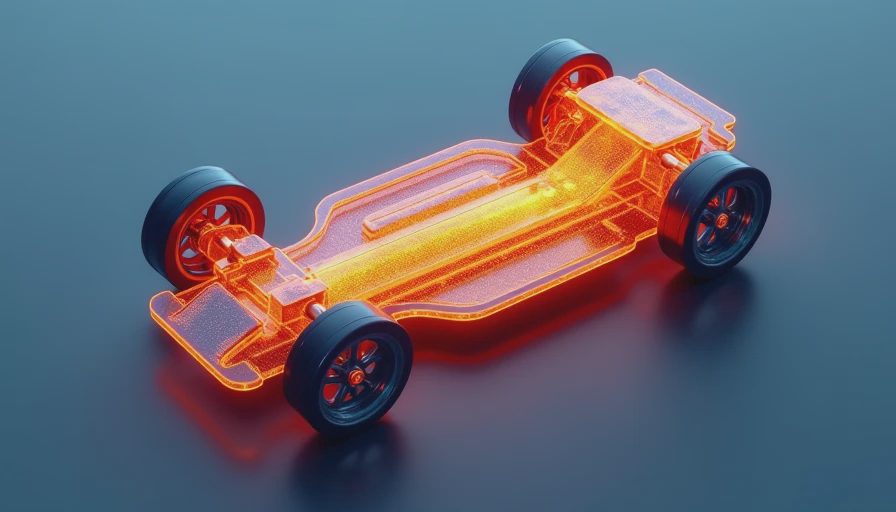
From behind the wheel, what stays with you is the feeling of rightness. A chassis that doesn't fight you, that lets the suspension do its work, that makes you trust it at seven-tenths and beyond. Whether it's a Ferrari V12 or a four-cylinder Alfa, the quality of that chassis is what separates a car you drive from a car you just "move." FEA gives engineers the tools to make that feeling more accessible than ever. But it doesn't write the story—the designers and drivers do. Every car has a story, and FEA is just the latest chapter in the century‑old quest for the perfect connection between road, machine, and driver.
Ready to feel that difference for yourself? Next time you're at a track day or a Cars & Coffee, find a modern chassis that's been shaped by FEA—like a Porsche 718 Cayman GT4 or a Lotus Emira. Walk around it, sit in it, and then take it for a drive. You'll feel the heritage and the future, all in one perfectly stiff, perfectly light structure. That's the magic of modern engineering, and it's a story worth sharing.