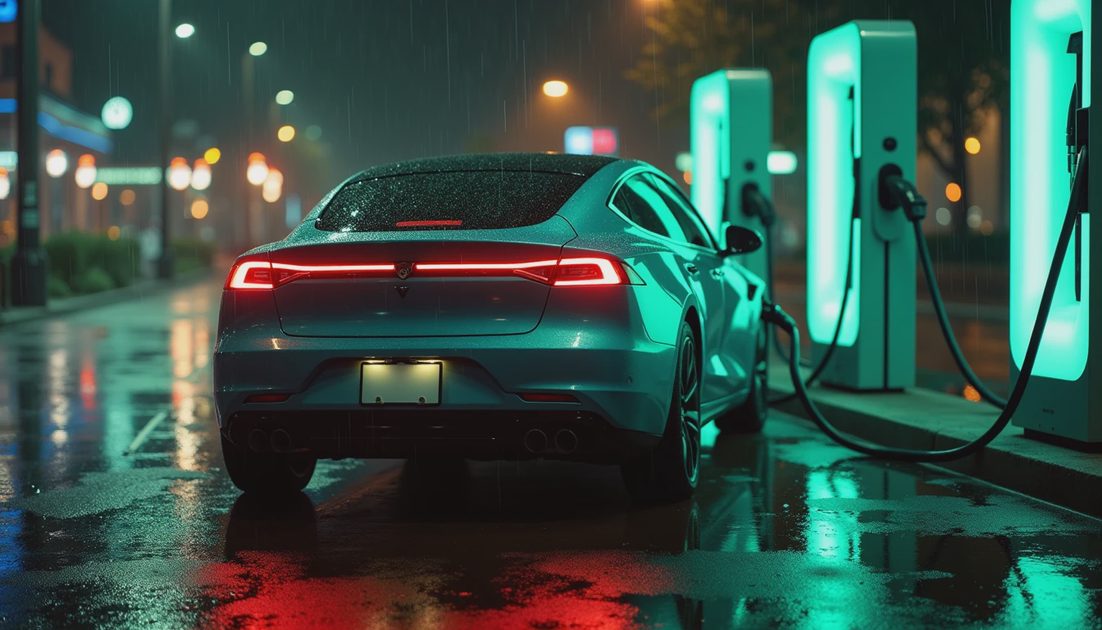
Electric Cars Aren’t Magic—They’re a Beautifully Simple Bargain of Motors, Batteries, and Torque
There’s a moment the first time you roll into the throttle of a good EV when your brain does that quick double-take—like it missed a gear change that never came. No crescendo of revs, no mechanical clearing of the throat, just clean, instant shove. For someone raised around carbureted V8s and concours-correct hose clamps, that seamless surge feels almost like cheating. But it isn’t magic. It’s an elegantly straightforward partnership: an electric motor taking orders from a battery, turning stored electricity into motion with fewer moving parts—and fewer excuses.
Electric vehicles, as the eMobility Academy piece lays out, are simply automobiles powered by electricity instead of gasoline or diesel. The core idea is almost disarmingly direct: store energy in a battery, feed it to an electric motor, and let that motor convert electrical energy into motion. Plug it in at a standard outlet or a dedicated charging station, top the battery back up, repeat.
And yes, there’s plenty of innovation wrapped around that loop. But the fundamentals matter because they explain why EVs feel the way they do—and why they’re rewriting what “normal” looks like in the driveway, the service bay, and the broader emissions conversation.
The EV’s secret sauce: a “dance” between electricity and mechanics
The article frames EV propulsion as a shift in how vehicles move, and I like that phrasing because it puts the emphasis where it belongs: on the experience. In a traditional internal combustion car, motion starts with controlled explosions, then gets negotiated through a busy chain of parts. In an EV, movement comes from the interaction between two main characters—battery and motor—working in tight coordination.
The motor’s job is to create motion from stored energy. In practice, that means electric propulsion is shaped by things the source calls out plainly: how fast the motor spins, the force it generates (torque), and how power flows. The result, in real-world driving terms, is that smoothness EV owners love to brag about (and that skeptics secretly enjoy the first time they try it). There’s no waiting for a downshift, no building boost, no hunting a power band. The response can feel immediate because the motor is directly translating electrical energy into turning force.
That immediacy isn’t just a parlor trick; it’s the defining character trait of modern electric driving. Even at gentle speeds, the car feels awake. The source also points out that this new way of moving is “more enjoyable and eco-friendly,” and while “enjoyable” is subjective, that smooth, quiet shove is a very real part of why so many people convert after a single drive.
Fewer moving parts, fewer headaches—why EVs change ownership as much as driving
One of the most practical points in the piece is also the least glamorous: electric propulsion “simplifies how vehicles work,” with fewer moving parts than traditional engines. That matters because complexity is usually where maintenance lives. An internal combustion engine is a symphony of components that must all behave under heat, pressure, and time. EV drivetrains, by comparison, can be mechanically simpler, which the source ties to “less maintenance and fewer complications.”
That doesn’t mean EVs are maintenance-free unicorns. Tires still wear, brakes still exist, and anything on four wheels will find a way to age. But the argument here is fundamental: fewer moving parts generally means fewer mechanical wear points. For everyday owners—especially those who don’t collect tools the way my family collects Italian trim pieces—that can be a big shift in the ownership equation.
And it changes how we talk about performance, too. In old-school circles, “performance” often meant chasing horsepower and revs. EV performance, as framed here, is as much about efficient power flow and torque delivery as it is about drama. Different thrills, different engineering flex.
The bigger picture: sustainability isn’t a badge, it’s the point
The source doesn’t mince words about why EVs matter beyond the driving experience: they “play a pivotal role in reducing emissions and promoting environmental sustainability.” The article positions the transition from internal combustion engines to electric propulsion as a way to reduce our ecological footprint. That’s the macro story—bigger than any one model, bigger than any one charging network, and frankly bigger than the usual comment-section arguments.
What’s refreshing is that the piece keeps returning to the idea that EV identity isn’t just “battery instead of tank.” It describes electric vehicles as a blend of three key components: electric motors, batteries, and innovation—working “in a harmonious blend” toward a more electrified future.
That’s a useful framing because it avoids the lazy assumption that EVs are only about virtue signaling or cost savings. They’re a technological pivot in how we convert energy into motion—one that happens to align neatly with emissions goals and urban air-quality realities.
Heritage Note: From fuel-and-spark to volts-and-torque
Car history is full of moments when propulsion gets rewritten—when yesterday’s “proper” powertrain becomes tomorrow’s museum piece. The source describes EV propulsion as a new “dance between electricity and mechanics,” and that’s exactly how it feels in lineage terms: not a rejection of driving, but a new chapter in how we get motion. Just like early motoring displaced horses, electric motors and batteries are now displacing combustion in everyday transport—while redefining what smooth, responsive performance means.