From 10 mph to supercars: the classic-car innovations that rewired how we drive
There’s a particular kind of thrill that only a true milestone car delivers. Not the “0–60 brag” kind, but the quieter goosebumps you get when you realize you’re looking at the exact moment the whole hobby pivoted. A shape, a mechanism, a manufacturing trick—something that didn’t just make one model better, but changed what cars could be afterward.
That’s the spine of the McCandless Collection’s timeline of classic-car innovations: a brisk ride from the first true automobile to the technology-soaked machines that started bridging classic character with modern brains. It reads like a family tree where each generation inherits a little more capability—and a little more audacity.
Where the story really starts: 1886 and a three-wheeled mic drop
We all love to argue origins at car shows (usually within earshot of an espresso stand), but 1886 is the cleanest line in the sand. Karl Benz’s Benz Patent-Motorwagen is widely considered the first true automobile, and the details matter because they show how raw the idea still was: three wheels, a single-cylinder engine, and a claimed top speed of up to 10 mph.
Ten. Miles. Per. Hour.
And yet, that number isn’t the point. The point is that it moved under its own power with a purpose-built system—an engineered statement that the horse wasn’t the only answer anymore. Every later debate about drivetrains and layouts traces back to this moment when the concept of “car” became something distinct.
Heritage Note: If you’ve ever geeked out over a weird prototype at a concours—some hand-formed, pre-production oddball that “doesn’t make sense”—the Patent-Motorwagen is the original. It’s the seed crystal. Everything else formed around it.
1908: The Model T didn’t just change cars—it changed people
By 1908, the automotive age needed its breakthrough not in invention, but in access. Enter Henry Ford and the Model T. The McCandless timeline hits the key truth: assembly line production drastically reduced manufacturing costs, making cars affordable for the average American.
That line is why the Model T isn’t merely important—it’s seismic. The industry didn’t simply learn how to build cars; it learned how to build *enough* cars to change daily life. The Model T democratized personal transportation, and it’s hard to overstate how much that reshaped everything downstream: road building, suburban growth, the parts ecosystem, even the idea that a working family could own mobility.
Heritage Note: Today’s “affordable performance” arguments—what belongs, what’s real, what counts—owe a debt to the Model T’s core disruption: moving the car from novelty to normal.
The 1920s: Making cars usable, safer, and undeniably glamorous
The 1920s weren’t just about flashy coachwork and brightwork. They were about making the car friendlier to live with and less likely to bite you. Electric starters replaced hand cranks, a change that sounds quaint until you remember what hand-cranking could do to an arm if an engine kicked back.
Safety and control took a leap too. Hydraulic brakes, introduced in 1918 by Duesenberg, show up in the McCandless timeline as one of those quietly huge engineering steps. Better braking doesn’t sell posters, but it changes confidence—and confidence changes speed.
McCandless points to a specific jewel from the era: its 1929 Duesenberg Model J, described as the era’s luxury and innovation distilled, with a powerful straight-eight engine and elegant design. This is the decade where the car becomes both machine and statement, and where engineering excellence starts getting dressed in formalwear.
1930s: Art Deco streamlining and the Cord that looked like tomorrow
The 1930s brought the influence of Art Deco into automotive design, pushing sleek, aerodynamic shapes that still look right today. But design wasn’t the only story. The 1936 Cord 810 in the McCandless Collection gets the spotlight for good reason: front-wheel drive and concealed headlights—two features that still feel like modern talking points when they show up on a spec sheet.
This is the era where “innovation” stops being a straight line and starts branching into ideas that will cycle in and out of fashion for decades. The timeline also notes the introduction of the V8 engine in this decade, signaling the industry’s growing appetite for power and performance.
Heritage Note: The Cord 810’s concealed headlights are a reminder that design trends are rarely new—just reinterpreted. Every time a modern car tries a dramatic lighting trick, there’s a ghost of the 1930s grinning in the background.
1940s: Comfort tech arrives—then sets the table for horsepower wars
After World War II, the car world hit a stride of rapid advancement. The McCandless timeline calls out three technologies that fundamentally changed the driving experience: automatic transmissions, power steering, and improved suspension systems.
What I love about this era is how it reframed “performance.” Not everything was about speed. Some of it was about endurance—how long you could drive, how little the car asked of you, how smoothly it absorbed the world. Those comfort and control upgrades didn’t just make cars nicer; they made them *easier to drive fast* when the next era arrived.
And yes, the timeline draws the line from these post-war innovations straight into the muscle car era of the 1950s and 1960s.
1950s–1960s: Muscle, meet mass appeal (hello, Mustang)
When American muscle rises, it does so with unmistakable attitude: powerful V8 engines and bold, aggressive styling. McCandless anchors that story with an icon it showcases: a 1965 Ford Mustang.
The Mustang’s legend isn’t only that it performed. It’s that it hit a sweet spot of performance, affordability, and stylish design—enough to become a cultural phenomenon. This is where the car stops being merely transportation (or merely luxury) and becomes identity you can park in your driveway.
Heritage Note: The Mustang’s real innovation wasn’t a single component—it was the recipe. Build a car that looks like freedom, price it so people can actually buy it, and you’ve changed the culture, not just the catalog.
1960s–1970s: Europe answers with the supercar—art that happens to be fast
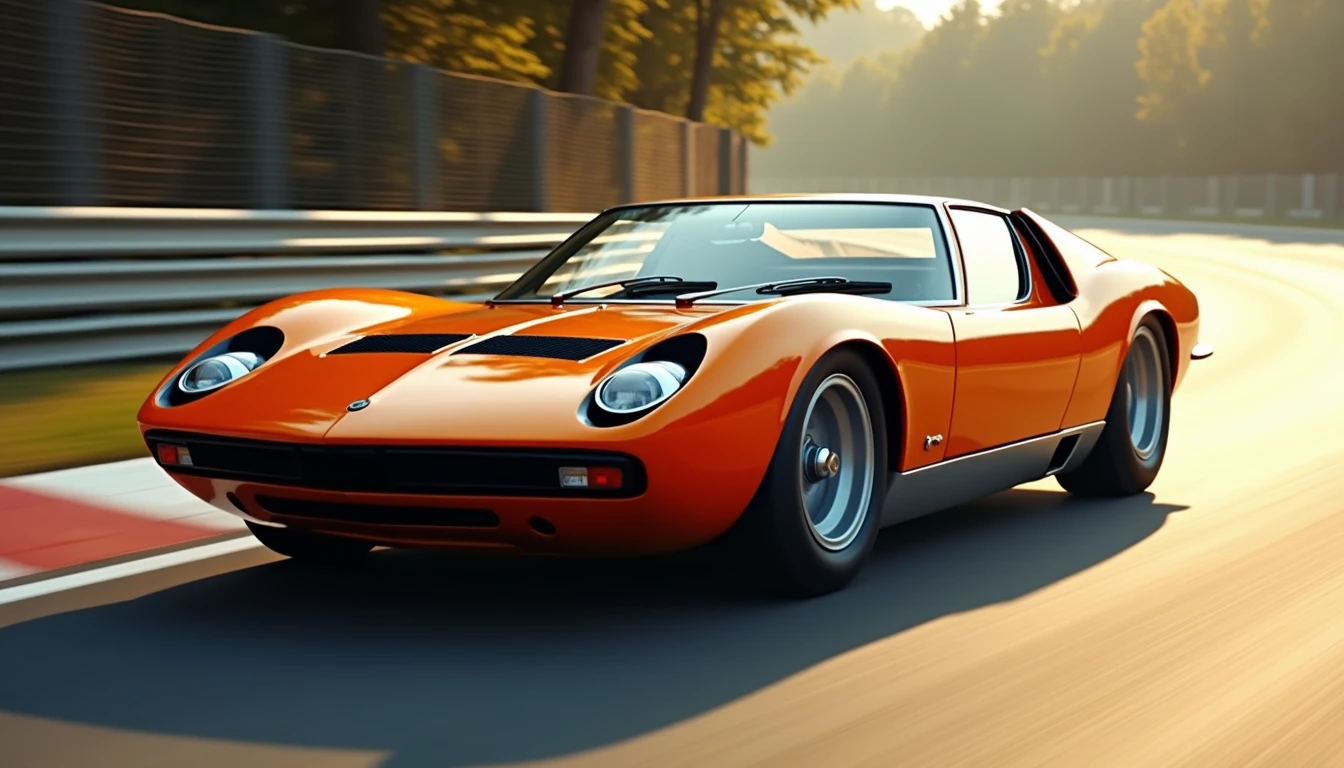
While Detroit was flexing its V8 muscles, Europe was rewriting the sports car rulebook. The McCandless timeline points to European brands like Ferrari, Lamborghini, and Porsche revolutionizing the segment, and it name-checks the birth of the supercar with models such as the Ferrari 250 GTO and Lamborghini Miura setting new standards for speed and design.
In the collection, a 1971 Lamborghini Miura SV stands as the era’s poster child—innovation and elegance in one wedge-shaped heartbeat. The Miura didn’t just go fast; it looked like a new species. It’s the kind of car that makes even seasoned enthusiasts stop mid-sentence.
1980s–1990s: The “modern classic” era begins—computers slip into the conversation
The late 20th century is where classic design starts living alongside modern technology in a way that feels familiar today. The McCandless timeline calls out fuel injection systems, turbocharging, and electronic control units (ECUs) becoming standard, enhancing performance and efficiency.
It also highlights a representative example in the collection: a 1989 Porsche 911 Carrera, described as a blend of tradition and innovation. That’s the magic of this period. The silhouettes still feel analog, but the underpinnings are starting to think for you—metering fuel, managing timing, optimizing behavior in the background.
Heritage Note: If you’ve ever heard someone say, “It’s the last *real* one,” the 1980s and 1990s are where that argument gets complicated. This is when the line between mechanical purity and technological progress stops being obvious.
2000s to today: new tech, old soul—and the hobby’s next argument
The McCandless timeline closes by noting that the 21st century has brought advancements in electric and autonomous vehicle technology, even if those innovations can feel at odds with what classic-car people traditionally love.
Here’s my take: the hobby has always been built on innovation. The Benz was radical. The Model T was disruptive. Hydraulic brakes were a safety revolution. Concealed headlights were a design mic drop. ECUs were a quiet takeover. So when we talk about modern tech—especially electrification—we’re not watching the end of the story. We’re watching the next chapter argue its way onto the lawn.
The best classic cars aren’t sacred because they’re old. They’re sacred because they changed the world.