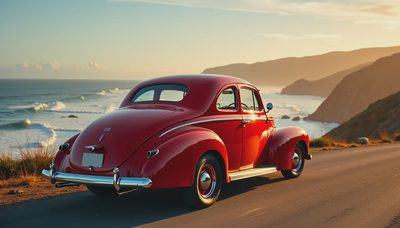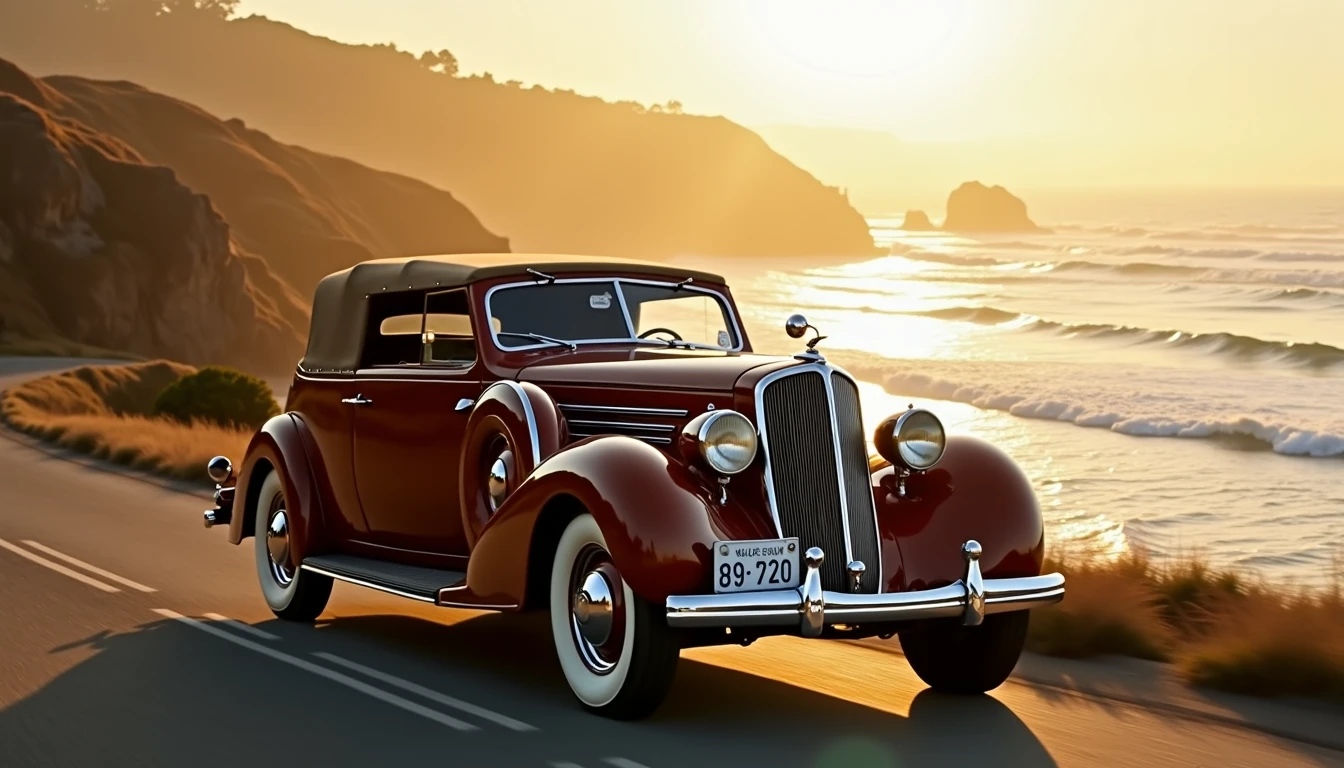
Hudson: The Detroit Upstart That Defined Modern Performance Long Before the Big Three Caught On
There's a moment in every great automotive lineage where the machinery stops being a carriage with an engine and starts feeling like a true machine. For Hudson, that moment wasn't a single breakthrough; it was a relentless parade of them, starting with a department store tycoon's wallet and a mechanic's dream. While the industry giants were still figuring out assembly line rhythm, Hudson was busy inventing the template for modern performance, luxury, and engineering redundancy.
By 1909, the automobile had shed its reputation as a passing fad or a rich man's toy. In Detroit, eight businessmen saw the writing on the wall and organized a new company with a bold target: build a car that sold for less than $1,000. Adjusted for inflation, that's roughly $26,000 today—a serious investment, but accessible enough to change the market. The venture took its name from Joseph L. Hudson, the entrepreneur behind Hudson's department store, who provided the capital. Roy D. Chapin, Sr., brought the automotive expertise to the table.
The Hudson Motor Car Company organized in February 1909, and by July, the first Hudson Twenty rolled out of a small factory. The market responded immediately. Hudson sold 4,000 units in 1909, followed by 4,508 in 1910 and 6,485 in 1911. By 1914, the company had already standardized left-hand drive for the American market, a shift that would soon become industry law.
The Department Store Tycoon's Gamble
Hudson didn't just sell cars; they sold engineering credibility. In 1916, they introduced the Super Six, a straight-six engine that redefined smoothness and power.
> Heritage Note: The 1916 Super Six didn't just move metal; it moved the industry. Its refinement and torque delivery set the benchmark for inline-six engines, proving that six cylinders could outclass the rougher, vibration-prone eights of the era. This engine family became the backbone of Hudson's reputation for performance, influencing the architecture of smooth-running powertrains for decades to come.
To capture the budget-conscious buyer, Hudson launched the Essex brand in 1919, aiming directly at Ford and Chevrolet. Essex offered one of the first affordable sedans, and the strategy worked. By 1925, combined Hudson and Essex sales vaulted the company to the third-largest automobile manufacturer in the United States. They expanded globally that same year, establishing factories in England and Belgium. By 1929, Hudson was producing 300,000 cars annually.
The brand hierarchy evolved as the decade turned. In 1930, Hudson introduced a new flathead inline-eight engine for its flagship line, while Essex continued with the Super Six. Amelia Earhart herself promoted the Essex-Terraplane in 1932, lending star power to the lineup. The Essex nameplate was eventually dropped in 1934, and by 1938, the Terraplane was rebranded as the Hudson 112.
Suspension, Switches, and the Electric Hand
While sales climbed, the engineering department got restless. Hudson's approach to innovation was practical, sometimes quirky, but always focused on the driver's experience.
In 1935, Hudson offered the "Electric Hand," a Bendix-manufactured option that replaced the floor-mounted shift lever with an electric gear selector on the steering column. It was an electro-mechanical automatic shifting system, though it still required conventional clutch action. Hudson engineers, ever the realists, knew early electronics could be temperamental. Cars equipped with the Electric Hand carried a conventional shift lever in clips under the dash as a backup. If the system failed, you could grab the lever and drive home. That's redundancy Detroit style.
Ride quality saw a massive leap in 1936 with the introduction of "radial safety control" and "rhythmic ride." Hudson suspended the live front axle from two steel bars in addition to leaf springs. This allowed for longer, softer springs that prevented bumps and heavy braking from shoving the car off course. The packaging was equally impressive; the 1936 Hudson boasted 145 cubic feet of interior space, dwarfing the 121 cubic feet found in competing cars, with a trunk that swallowed 21 cubic feet of luggage.
Betty Thatcher's 1941 Vision
1939 brought a different kind of horsepower. Hudson became the first American automobile manufacturer to hire a female automotive designer: Betty Thatcher. A graduate of the Cleveland School of Arts, Thatcher joined the company and immediately left her mark.
Thatcher designed the interior instrument panel, exterior trim with side lighting, and interior fabrics for the 1941 Hudson. Her tenure lasted until 1941, when she left the company after marrying Joe Oros, a designer for Cadillac, to avoid a conflict of interest. Her work on the 1941 model ensured that Hudson's cabin ergonomics and styling were as forward-thinking as its chassis.
The engineering didn't stop there. By 1940, Hudson had introduced coil-spring independent front suspension, aircraft-style shock absorbers mounted within the front springs, and true center-point steering. These were major advances in handling that rivals were still dreaming about. Hudson had built a car that handled, rode, and innovated with a maturity that belied its origins as a sub-$1,000 upstart. The name may have eventually faded, but the blueprint Hudson wrote for modern performance cars is still visible in every garage from Monterey to the Nürburgring.